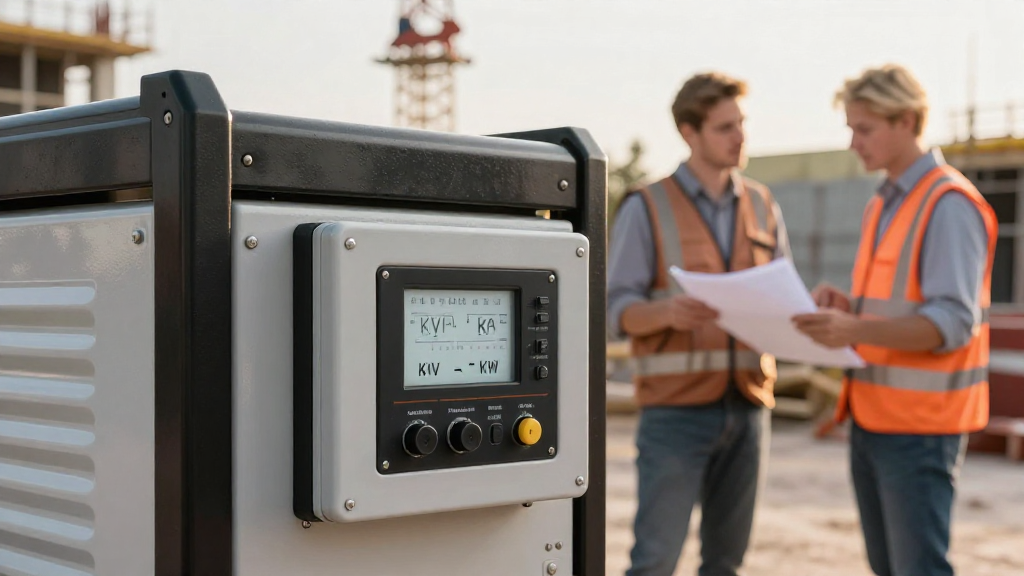
Understanding generator kVA vs kW is essential for anyone involved in selecting or using generators.
This article will clarify the distinctions and relationships between these two crucial measurements, helping you make informed decisions for your power needs.
What Do kVA and kW Mean?
kW (Kilowatt) is a unit of measurement used to quantify the actual power generated or consumed by an electrical device.
It measures the real power, which is the usable power that performs work.
Conversely, kVA (Kilovolt-Ampere) refers to the apparent power in an electrical circuit.
It is the product of voltage and current but does not account for the phase difference between them.
To put it simply:
- kW = Effective power (work done)
- kVA = Total power (including wasted energy)
Why Do We Need to Differentiate Between kW and kVA?
Understanding generator kVA vs kW is critical for several reasons:
-
Load Calculation: Knowing the difference helps in calculating the actual load that machinery and appliances will place on a generator.
-
Efficiency Evaluation: Determining how efficiently a generator is working becomes easier with a clear distinction.
-
Power Factor Understanding: It enables users to grasp the concept of power factor, which represents the ratio of real power to apparent power.
Without a clear understanding, you may end up under-sizing or over-sizing a generator, leading to inefficiencies.
How Are kVA and kW Related?
The relationship between kVA and kW revolves around the power factor (PF).
The power factor is the ratio of real power (kW) to apparent power (kVA) and is given by the formula:
[
\text{Power Factor (PF)} = \frac{\text{kW}}{\text{kVA}}
]
For instance:
- If a generator has a power factor of 0.8 and operates at 100 kVA, the calculation for kW would be:
[
\text{kW} = \text{kVA} \times \text{PF} = 100\,\text{kVA} \times 0.8 = 80\,\text{kW}
]
Key Takeaway: Higher power factors indicate that a greater portion of apparent power is being converted to real work.
What Is the Role of Power Factor in Generator Ratings?
Knowing how to interpret the power factor is crucial when selecting a generator.
It will indicate how much of the generator’s capacity is actually usable.
Typical Power Factor Ratings
- Residential Load: Usually around 0.9
- Industrial Load: Can range from 0.7 to 0.95, depending on the type of equipment used
Why does this matter?
When you select a generator, assume that the kVA rating for your equipment will provide the kW output based only on the PF.
Hence, if you ignore the power factor, you may face:
- Overloading the generator
- Wasted power, resulting in higher fuel costs
- Inefficient operation, leading to premature wear and tear
How to Convert Between kVA and kW?
Basic Conversion Formula
To summarize the formula from earlier, you can use this equation:
[
\text{kW} = \text{kVA} \times \text{PF}
]
To reverse the equation:
[
\text{kVA} = \frac{\text{kW}}{\text{PF}}
]
Example Scenarios
- Scenario 1: If you have a generator rated at 60 kW and a power factor of 0.9, the kVA can be calculated as follows:
[
\text{kVA} = \frac{60\,\text{kW}}{0.9} \approx 66.67\,\text{kVA}
]
- Scenario 2: For a generator with a kVA rating of 50 and a power factor of 0.85:
[
\text{kW} = 50\,\text{kVA} \times 0.85 = 42.5\,\text{kW}
]
Importance of Proper Ratings
Ensuring that your generator’s kVA and kW ratings align with your power needs will prevent costly mistakes and ensure reliable operation.
How Does Generator Sizing Affect Performance?
Factors to Consider
When determining the size of a generator, consider key factors:
- Type of Load: Residential vs. industrial loads
- Starting Requirements: Equipment with high inrush current requires larger generators
- Duration of Use: Continuous vs. backup power
Tips for Proper Sizing:
- Always calculate total wattage needs accurately.
- Factor in the starting wattage for heavy-duty machinery.
- Consider future expansion needs, if applicable.
The Consequences of Under-sizing or Over-sizing Generators
-
Under-sizing may lead to constant overload, resulting in overheating and premature damage.
-
Over-sizing can cause inefficient operation, resulting in increased fuel consumption and higher operational costs over time.
What Are the Common Applications for kW and kVA Ratings?
Understanding generator kVA vs kW becomes essential in various scenarios:
-
Home Use: Often rated in kW; focus on overall power needs for appliances.
-
Commercial Spaces: Typically rated in kVA; accommodates lighting loads and industrial equipment.
-
Construction Sites: Use both ratings depending on machinery and tools on-site, needing a proper kVA to kW understanding for effective operation.
What Equipment Needs Special Attention?
Certain types of equipment require specific considerations when calculating kVA and kW:
- Motors: Have high inrush requirements; consider their full load and starting kVA ratings.
- Transformers: Use apparent power ratings in kVA, often showing less real power available due to losses.
- Uninterruptible Power Supplies (UPS): Ensure that the UPS output ratings match the load requirements in kW.
Conclusion: Why Is Understanding Generator kVA vs kW Essential?
Understanding generator kVA vs kW is crucial for ensuring you select the right generator for your needs.
By recognizing how kVAs and kWs interact through power factors, and understanding how to convert between these units, you can optimize your power solutions effectively.
Armed with this knowledge, you can:
-
Improve efficiency by selecting appropriately sized generators.
-
Limit wear on electrical equipment, and ultimately, save costs.
Don’t underestimate the importance of these measurements; being well-informed can make all the difference in your power management strategies.
Make sure to keep this guide handy as you navigate the world of generators to ensure you are powered up correctly!