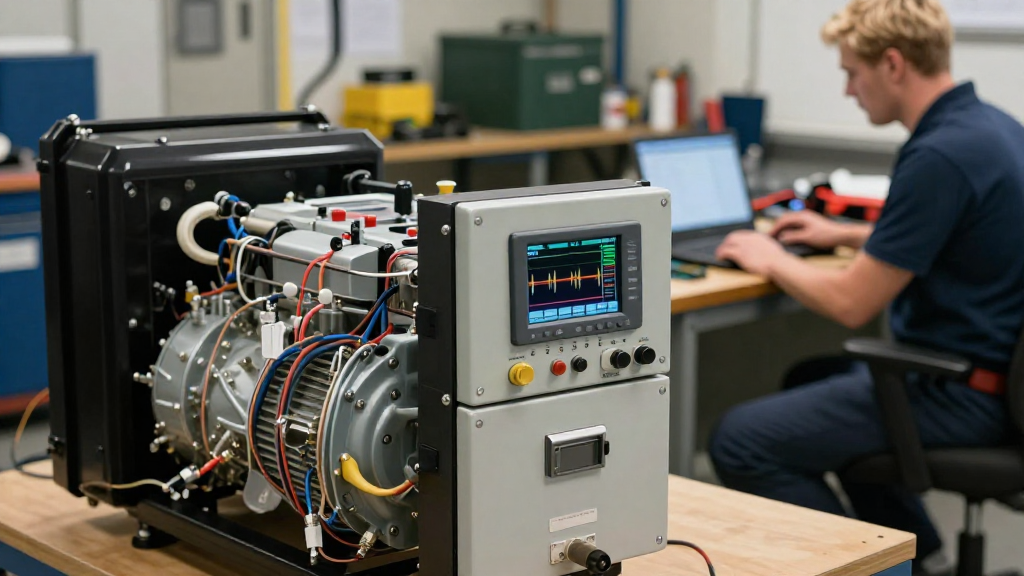
Understanding how to calculate generator harmonic distortion is crucial for ensuring the proper functioning of electrical systems. Harmonic distortion can lead to inefficiencies in electrical equipment, increased heating, and ultimately, equipment failure.
In this article, we will explore the various aspects of generator harmonic distortion, the steps to calculate it, and how to mitigate its effects.
What is Generator Harmonic Distortion?
Generator harmonic distortion refers to the distortion of voltage and current waveforms in electrical systems caused by non-linear loads. Non-linear loads, such as computers and LED lights, draw current in irregular pulses, causing the waveforms to deviate from their ideal shapes.
Why is it Important to Calculate Harmonic Distortion?
Calculating harmonic distortion in generators is essential for several reasons:
- Equipment Longevity: High levels of harmonic distortion can lead to overheating of generators and other electrical equipment.
- System Reliability: Harmonics can cause equipment malfunctions and outages.
- Compliance: Many electrical standards require monitoring and limiting of harmonic distortion.
- Efficiency: Lower distortion leads to improved efficiency and reduced operational costs.
How is Harmonic Distortion Measured?
Before we delve into how to calculate generator harmonic distortion, it’s crucial to understand the measurement techniques. Harmonic distortion is typically expressed as a percentage of:
- Total Harmonic Distortion (THD): This measures the total harmonic content in relation to the fundamental frequency.
To compute THD, we need the following steps:
- Identify the Fundamental Frequency: Commonly 60Hz in North America and 50Hz in other regions.
- Measure the Harmonic Currents: Identify and measure the harmonic currents (e.g., 3rd, 5th, 7th) using an oscilloscope or power analyzer.
- Apply the Formula: Use the following formula to calculate THD:
[
THD = \sqrt{\frac{I_2^2 + I_3^2 + I_4^2 + … + I_n^2}{I_1^2}} \times 100
]
Where (I_1) is the fundamental current, and (I_2), (I_3), etc., are the harmonic currents.
Steps for Calculating Generator Harmonic Distortion
Now, let’s get into the step-by-step process of how to calculate generator harmonic distortion effectively.
1. Gather Necessary Equipment
To begin, you’ll need specific tools, including:
- Power Quality Analyzer: For measuring voltage and current waveforms.
- Oscilloscope: To visualize the waveforms.
- Computer Software: Many power analyses software programs can calculate THD automatically.
2. Measure the Input Voltage and Currents
Use your power quality analyzer to measure the voltage and current across the generator. Ensure you record the fundamental frequency and the peak values.
3. Record Harmonics
Using the oscilloscope, measure the amplitude of the various harmonic components.
- Focus on key harmonics:
- 3rd (possible triplen),
- 5th,
- 7th,
- 9th,
- 11th,
- up to the 31st harmonic.
4. Calculate the THD Value
Once you have measured all the necessary components, you can plug them into the THD formula mentioned above.
For example, if:
- (I_1 = 10A)
- (I_3 = 2A)
- (I_5 = 1A)
Then:
[
THD = \sqrt{\frac{2^2 + 1^2}{10^2}} \times 100 = \sqrt{\frac{4 + 1}{100}} \times 100 = \sqrt{0.05} \times 100 = 22.36\%
]
5. Analyze the Results
After calculating the THD, compare the value against acceptable levels (usually ≤ 5% for generator sets based on IEEE 519 standards). If your results stray into the unsafe zone, consider mitigation strategies.
What Can You Do About High Harmonic Distortion?
If you find that your generator harmonic distortion is high, several strategies can help mitigate this issue:
-
Harmonic Filters: Install passive or active harmonic filters to clean the power.
-
Use of Isolation Transformers: These can help in reducing the effect of harmonics on the system.
-
Load Balancing: Ensure even load distribution can help minimize distortions.
-
Upgrade Equipment: If certain devices are known to cause distortion, consider replacing them with more harmonic-friendly options.
-
Limit Non-Linear Loads: Wherever possible, reduce the usage of non-linear loads on the generator.
Conclusion
Calculating generator harmonic distortion is not only necessary for maintaining the efficiency and reliability of your electrical systems but also plays a significant role in compliance with regulatory standards.
By understanding how to calculate generator harmonic distortion, you can identify potential issues with your electrical system and take the necessary action to mitigate problems. Proper measurement and management of harmonics are essential steps in ensuring the longevity and effectiveness of your generators.
In summary, consider investing in quality measurement tools, regularly monitor harmonic levels, and implement corrective measures when needed. This proactive approach will safeguard your electrical systems, enhance performance, and ensure smooth operations.
If you want to dive deeper into generator maintenance or require more insights on electrical standards, don’t hesitate to reach out for expert advice!